Chapter 1 - Real Numbers
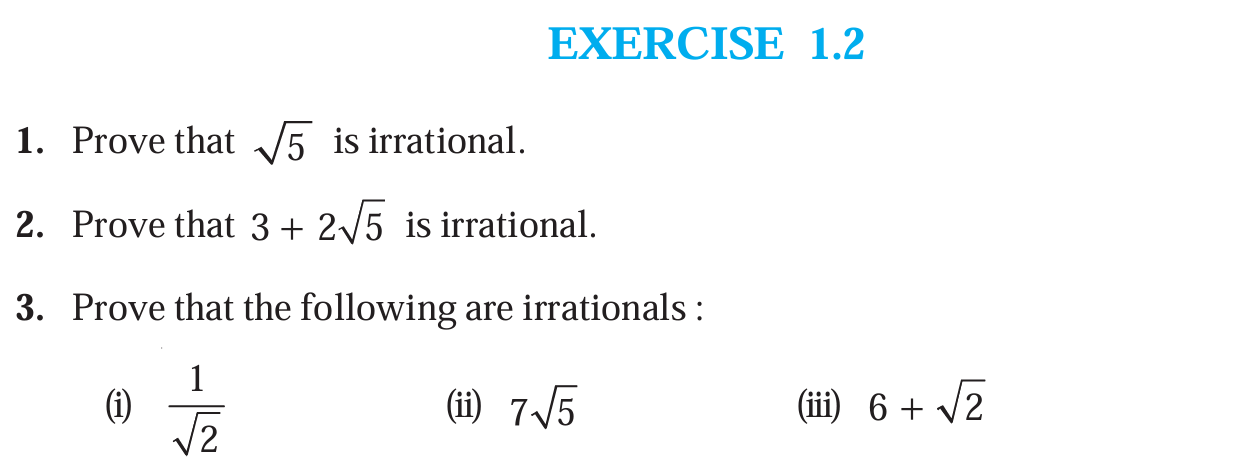
Prove that √5 is irrational.
Assume that √5 is rational. Then it can be written as
√5 = p/q, where p and q are co-prime integers and q ≠ 0.
Squaring both sides,
5 = p2/q2
p2 = 5q2
Therefore, p2 is divisible by 5, so p is divisible by 5.
Let p = 5k.
Substituting,
25k2 = 5q2
q2 = 5k2
Hence q is also divisible by 5.
Thus p and q have a common factor 5, which contradicts that they are co-prime.
Therefore, √5 is irrational.
Prove that 3 + 2√5 is irrational.
Assume that 3 + 2√5 is rational.
Then,
2√5 = (3 + 2√5) − 3
Since the difference of two rational numbers is rational, 2√5 is rational.
Dividing by 2,
√5 is rational.
But this contradicts the fact that √5 is irrational.
Therefore, 3 + 2√5 is irrational.
Prove that the following are irrationals.
(i) 1/√2
Assume that 1/√2 is rational.
Then,
√2 = 1 ÷ (1/√2)
Therefore √2 becomes rational, which is impossible.
Hence, 1/√2 is irrational.
(ii) 7√5
Assume that 7√5 is rational.
Then,
√5 = (7√5)/7
Therefore √5 becomes rational, which is impossible.
Hence, 7√5 is irrational.
(iii) 6 + √2
Assume that 6 + √2 is rational.
Then,
√2 = (6 + √2) − 6
Therefore √2 becomes rational, which is impossible.
Hence, 6 + √2 is irrational.