Chapter 1 - Real Numbers
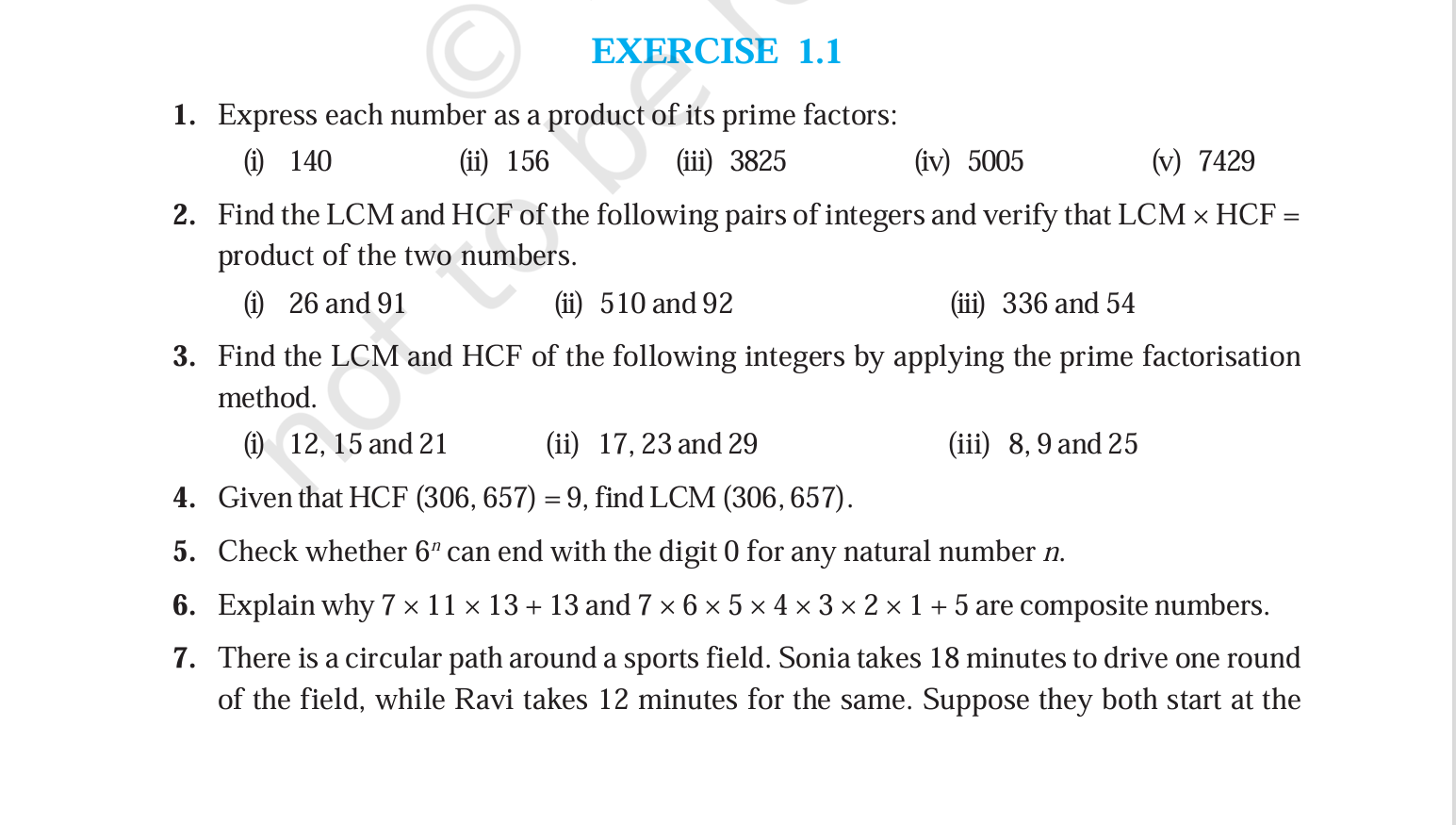
Express each number as a product of its prime factors.
(i) 140
140 = 2 × 70
= 2 × 2 × 35
= 2 × 2 × 5 × 7
140 = 22 × 5 × 7
(ii) 156
156 = 2 × 78
= 2 × 2 × 39
= 2 × 2 × 3 × 13
156 = 22 × 3 × 13
(iii) 3825
3825 = 5 × 765
= 5 × 5 × 153
= 5 × 5 × 3 × 51
= 5 × 5 × 3 × 3 × 17
3825 = 32 × 52 × 17
(iv) 5005
5005 = 5 × 1001
= 5 × 7 × 143
= 5 × 7 × 11 × 13
5005 = 5 × 7 × 11 × 13
(v) 7429
7429 = 17 × 437
= 17 × 19 × 23
7429 = 17 × 19 × 23
Find the LCM and HCF of the following pairs of integers and verify that LCM × HCF = Product of the two numbers.
(i) 26 and 91
26 = 2 × 13
91 = 7 × 13
HCF = 13
LCM = 2 × 7 × 13 = 182
Verification:
182 × 13 = 2366
26 × 91 = 2366
(ii) 510 and 92
510 = 2 × 3 × 5 × 17
92 = 22 × 23
HCF = 2
LCM = 22 × 3 × 5 × 17 × 23 = 23460
Verification:
23460 × 2 = 46920
510 × 92 = 46920
(iii) 336 and 54
336 = 24 × 3 × 7
54 = 2 × 33
HCF = 6
LCM = 24 × 33 × 7 = 3024
Verification:
3024 × 6 = 18144
336 × 54 = 18144
Find the LCM and HCF of the following integers by applying the prime factorisation method.
(i) 12, 15 and 21
12 = 22 × 3
15 = 3 × 5
21 = 3 × 7
HCF = 3
LCM = 22 × 3 × 5 × 7 = 420
(ii) 17, 23 and 29
All the numbers are prime numbers.
HCF = 1
LCM = 17 × 23 × 29 = 11339
(iii) 8, 9 and 25
8 = 23
9 = 32
25 = 52
HCF = 1
LCM = 23 × 32 × 52 = 1800
Given that HCF (306, 657) = 9, find LCM (306, 657).
We know that,
HCF × LCM = Product of the two numbers
9 × LCM = 306 × 657
LCM = (306 × 657) ÷ 9
LCM = 201042 ÷ 9
LCM = 22338
Check whether 6n can end with the digit 0 for any natural number n.
6 = 2 × 3
Therefore,
6n = (2 × 3)n
= 2n × 3n
A number ends with digit 0 only if it contains the factors 2 and 5.
But 6n contains only the factors 2 and 3 and no factor 5.
Therefore, 6n cannot end with the digit 0 for any natural number n.
Explain why 7 × 11 × 13 + 13 and 7 × 6 × 5 × 4 × 3 × 2 × 1 + 5 are composite numbers.
(i) 7 × 11 × 13 + 13
= 13 (7 × 11 + 1)
= 13 (77 + 1)
= 13 × 78
Since it has factors other than 1 and itself, it is a composite number.
(ii) 7 × 6 × 5 × 4 × 3 × 2 × 1 + 5
= 5 (7 × 6 × 4 × 3 × 2 × 1 + 1)
= 5 (1008 + 1)
= 5 × 1009
Since it has factors other than 1 and itself, it is also a composite number.
There is a circular path around a sports field. Sonia takes 18 minutes to drive one round of the field, while Ravi takes 12 minutes for the same. Suppose they both start at the same point and at the same time and go in the same direction. After how many minutes will they meet again at the starting point?
They will meet again after the LCM of 18 and 12.
18 = 2 × 32
12 = 22 × 3
LCM = 22 × 32
= 4 × 9
= 36
Therefore, they will meet again after 36 minutes.
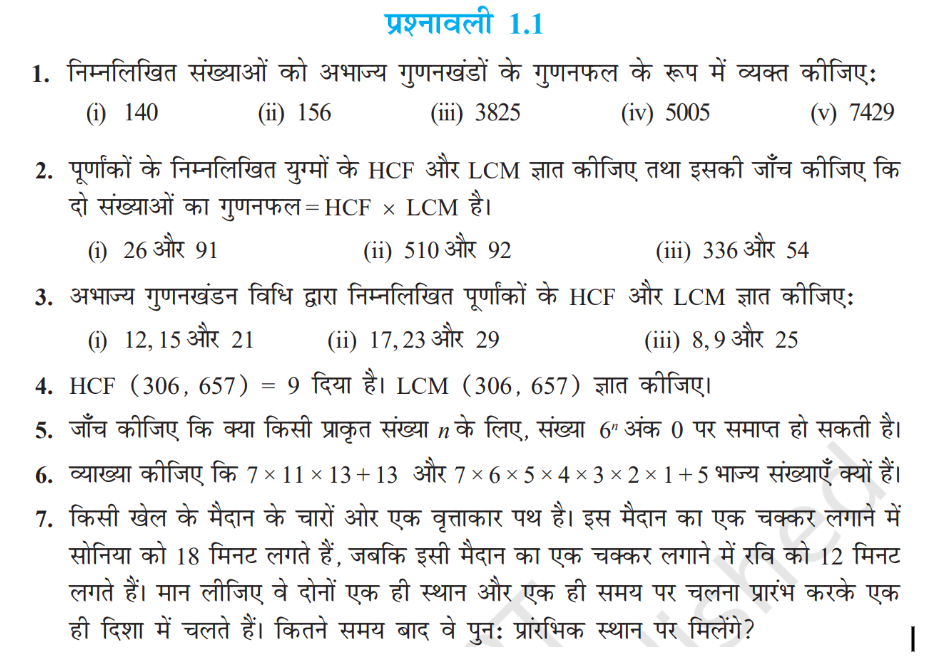
निम्नलिखित प्रत्येक संख्या को उसके अभाज्य गुणनखंडों के गुणनफल के रूप में व्यक्त कीजिए।
(i) 140
140 = 2 × 70
= 2 × 2 × 35
= 2 × 2 × 5 × 7
अतः 140 = 22 × 5 × 7
(ii) 156
156 = 2 × 78
= 2 × 2 × 39
= 2 × 2 × 3 × 13
अतः 156 = 22 × 3 × 13
(iii) 3825
3825 = 5 × 765
= 5 × 5 × 153
= 5 × 5 × 3 × 51
= 5 × 5 × 3 × 3 × 17
अतः 3825 = 32 × 52 × 17
(iv) 5005
5005 = 5 × 1001
= 5 × 7 × 143
= 5 × 7 × 11 × 13
अतः 5005 = 5 × 7 × 11 × 13
(v) 7429
7429 = 17 × 437
= 17 × 19 × 23
अतः 7429 = 17 × 19 × 23
निम्नलिखित पूर्णांकों के प्रत्येक युग्म का लघुत्तम समापवर्त्य (LCM) तथा महत्तम समापवर्तक (HCF) ज्ञात कीजिए तथा सत्यापित कीजिए कि
LCM × HCF = दोनों संख्याओं का गुणनफल।
(i) 26 तथा 91
26 = 2 × 13
91 = 7 × 13
महत्तम समापवर्तक (HCF) = 13
लघुत्तम समापवर्त्य (LCM) = 2 × 7 × 13 = 182
सत्यापन:
182 × 13 = 2366
26 × 91 = 2366
(ii) 510 तथा 92
510 = 2 × 3 × 5 × 17
92 = 22 × 23
महत्तम समापवर्तक (HCF) = 2
लघुत्तम समापवर्त्य (LCM) = 22 × 3 × 5 × 17 × 23 = 23460
सत्यापन:
23460 × 2 = 46920
510 × 92 = 46920
(iii) 336 तथा 54
336 = 24 × 3 × 7
54 = 2 × 33
महत्तम समापवर्तक (HCF) = 6
लघुत्तम समापवर्त्य (LCM) = 24 × 33 × 7 = 3024
सत्यापन:
3024 × 6 = 18144
336 × 54 = 18144
अभाज्य गुणनखंड विधि का प्रयोग करके निम्नलिखित संख्याओं का लघुत्तम समापवर्त्य (LCM) तथा महत्तम समापवर्तक (HCF) ज्ञात कीजिए।
(i) 12, 15 तथा 21
12 = 22 × 3
15 = 3 × 5
21 = 3 × 7
महत्तम समापवर्तक (HCF) = 3
लघुत्तम समापवर्त्य (LCM) = 22 × 3 × 5 × 7 = 420
(ii) 17, 23 तथा 29
तीनों संख्याएँ अभाज्य संख्याएँ हैं।
महत्तम समापवर्तक (HCF) = 1
लघुत्तम समापवर्त्य (LCM) = 17 × 23 × 29 = 11339
(iii) 8, 9 तथा 25
8 = 23
9 = 32
25 = 52
महत्तम समापवर्तक (HCF) = 1
लघुत्तम समापवर्त्य (LCM) = 23 × 32 × 52 = 1800
यदि HCF (306, 657) = 9 है, तो LCM (306, 657) ज्ञात कीजिए।
हम जानते हैं कि,
HCF × LCM = दोनों संख्याओं का गुणनफल
9 × LCM = 306 × 657
LCM = (306 × 657) ÷ 9
= 201042 ÷ 9
अतः LCM = 22338
जाँच कीजिए कि क्या किसी प्राकृतिक संख्या n के लिए 6n का अंतिम अंक 0 हो सकता है।
6 = 2 × 3
अतः
6n = (2 × 3)n
= 2n × 3n
किसी संख्या का अंतिम अंक 0 तभी होता है, जब उसके गुणनखंडों में 2 तथा 5 दोनों उपस्थित हों।
लेकिन 6n में केवल 2 तथा 3 गुणनखंड होते हैं, 5 का गुणनखंड नहीं होता।
अतः किसी भी प्राकृतिक संख्या n के लिए 6n का अंतिम अंक 0 नहीं हो सकता।
स्पष्ट कीजिए कि 7 × 11 × 13 + 13 तथा 7 × 6 × 5 × 4 × 3 × 2 × 1 + 5 मिश्रित संख्याएँ (Composite Numbers) क्यों हैं।
(i) 7 × 11 × 13 + 13
= 13 (7 × 11 + 1)
= 13 (77 + 1)
= 13 × 78
यह संख्या 13 तथा 78 का गुणनफल है। इसलिए इसके 1 और स्वयं के अतिरिक्त अन्य गुणनखंड भी हैं।
अतः 7 × 11 × 13 + 13 एक मिश्रित संख्या है।
(ii) 7 × 6 × 5 × 4 × 3 × 2 × 1 + 5
= 5 (7 × 6 × 4 × 3 × 2 × 1 + 1)
= 5 (1008 + 1)
= 5 × 1009
यह संख्या 5 तथा 1009 का गुणनफल है। इसलिए इसके 1 और स्वयं के अतिरिक्त अन्य गुणनखंड भी हैं।
अतः 7 × 6 × 5 × 4 × 3 × 2 × 1 + 5 भी एक मिश्रित संख्या है।
एक खेल मैदान के चारों ओर एक वृत्ताकार मार्ग है। सोनिया इस मार्ग का एक चक्कर 18 मिनट में तथा रवि 12 मिनट में पूरा करता है। यदि दोनों एक ही स्थान से, एक ही समय पर तथा एक ही दिशा में चलना प्रारम्भ करें, तो वे पुनः प्रारम्भिक बिंदु पर कितने समय बाद मिलेंगे?
दोनों पुनः प्रारम्भिक बिंदु पर तब मिलेंगे जब 18 और 12 का लघुत्तम समापवर्त्य (LCM) पूरा होगा।
18 = 2 × 32
12 = 22 × 3
LCM = 22 × 32
= 4 × 9
= 36
अतः सोनिया और रवि 36 मिनट बाद पुनः प्रारम्भिक बिंदु पर मिलेंगे।
Exercise 1.1 of Class 10 Maths Chapter 1 (Real Numbers) covers prime factorisation, HCF (Highest Common Factor), LCM (Least Common Multiple), and applications based on real numbers.
NCERT Class 10 Maths Chapter 1 Exercise 1.1 contains a total of 7 questions.
Yes. Questions based on HCF, LCM, prime factorisation and Euclid's Division Lemma are frequently asked in CBSE and State Board examinations.
Yes. DV Coaching Centre provides Exercise 1.1 solutions in both English and Hindi with step-by-step explanations.
Yes. You can download the complete Exercise 1.1 solutions PDF from this page.